
How the Ear Works
Understanding the remarkable process of how we hear—from sound waves to brain signals.
Your ear is a remarkable organ that transforms invisible sound waves into the rich world of sounds you experience every day. Understanding how this process works helps you appreciate why hearing loss occurs and how it can be treated.
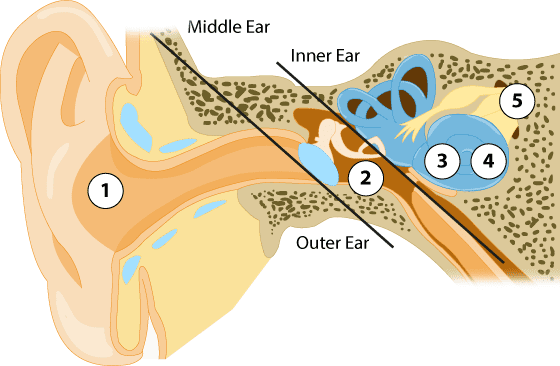
The Outer Ear
The visible part of your ear (called the pinna) is designed with grooves and ridges that naturally amplify sounds in the 2000-3000 Hz range—the frequencies most important for understanding speech. Sound waves travel down the ear canal toward the eardrum.
- Pinna collects and funnels sound waves
- Natural amplification of speech frequencies
- Ear canal lined with protective skin and fine hairs
- Earwax (cerumen) protects against bacteria and moisture
The Middle Ear
The eardrum (tympanic membrane) is remarkably thin but incredibly strong, thanks to its three-layer construction. When sound waves hit it, it vibrates, setting three tiny connected bones—the ossicles—into motion. These bones amplify the vibrations and transmit them to the inner ear.
- Eardrum vibrates in response to sound
- Three ossicles: malleus, incus, and stapes
- Ossicles strengthen and transmit vibrations
- Eustachian tube regulates pressure (opens when swallowing or yawning)
The Inner Ear
Deep within your skull lies the cochlea—a fluid-filled, snail-shaped structure that’s the true hearing organ. When vibrations reach it, the fluid moves, bending tiny hair cells that generate electrical signals. The cochlea processes frequencies from 20 Hz to 20,000 Hz, organized like a piano keyboard.
- Cochlea converts vibrations to electrical impulses
- Hair cells detect different frequencies
- Auditory nerve carries signals to the brain
- Semicircular canals handle balance (separate from hearing)
The Complete Hearing Process
In mere milliseconds, sound travels through this sophisticated five-step process: sound waves are collected by the outer ear, vibrate the eardrum, get amplified by the ossicles, move fluid in the cochlea, and trigger hair cells to send electrical signals up the auditory nerve to your brain—where they’re interpreted as recognizable sounds.
Questions?
Call us at 408-358-5123 to schedule a comprehensive evaluation if you have questions about how your hearing works.